



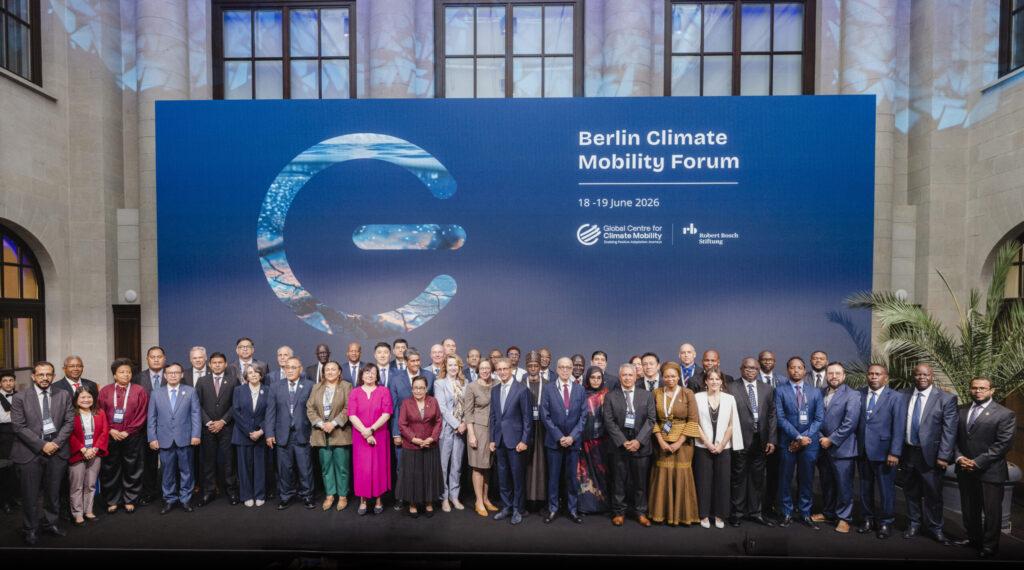
Berlin, 18 June 2026 – At the 2nd Berlin Climate Mobility Forum (BCMF), held on 18–19 June 2026 in Berlin, countries formally endorsed the first-ever Global Principles for Climate Mobility – marking a major step toward coordinated international action on climate mobility. Endorsing states include Colombia, Jamaica, South Africa, Nigeria, Kenya, Cyprus, Germany, The Maldives, Tuvalu, and Fiji. The conference is co-hosted by the Global Centre for Climate Mobility (GCCM) and the Robert Bosch Stiftung.
The Global Climate Mobility Principles represent the first UN Member State-led effort to consolidate a fragmented global policy landscape into a coherent, rights-based framework for addressing climate mobility – the displacement, migration, relocation and immobility of people due to climate impacts. Co-developed with governments from some of the most climate-vulnerable regions, shaped through consultations with more than 130 countries and input from over 1,000 organizations, they establish a shared foundation for international cooperation on one of the most pressing challenges of our time. The Berlin Climate Mobility Forum also marked the launch of the Climate Mobility Adaptation Agenda (CMAA) process. This broad-based effort will translate the Principles into concrete partnerships, policies, and investments.
The Berlin Climate Mobility Forum represents the largest international diplomatic gathering hosted in Berlin since the turn of the century. Over 100 nations from across Africa, the Pacific, the Caribbean, Latin America, Asia, and Europe – including 10 Heads of State and Government, 60 Ministers and Envoys and a dozen mayors – publicly expressed their support for the Climate Mobility Principles. Over 50 countries have formally endorsed the Principles to date, representing close to a third of the membership of the United Nations.
“Today, Berlin proved that multilateralism can still deliver. The international community came together in support of a shared roadmap for addressing climate mobility.” said Kamal Amakrane, Managing Director of the UN’s Global Centre for Climate Mobility. “We are working to anchor the Principles as the guiding compass for our shared journey – one that enables dignified, resilient, and positive community transitions in the face of the climate crisis.”
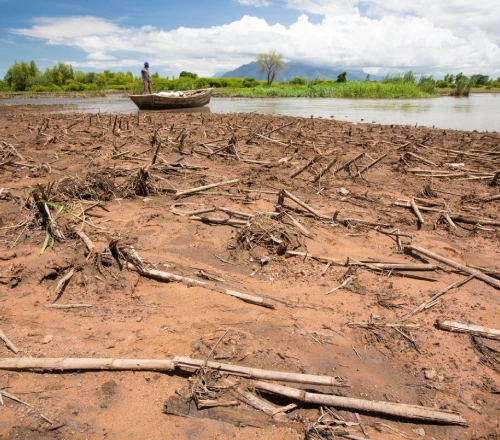
The urgency behind this initiative is clear. By 2050, up to 125 million people across Africa, the Greater Caribbean, and the Pacific could be displaced by climate impacts, while more than one billion people in low-lying coastal areas face growing threats to their homes, livelihoods, and cultural heritage. For many Small Island Developing States, these risks are existential.
The Global Climate Mobility Principles respond to this challenge with a comprehensive framework built on four core pillars:
- The “right to stay”: The Principles prioritize protecting communities’ ability to remain in their homes through locally-led adaptation, climate-resilient infrastructure, and localized finance – while ensuring those who cannot move are not trapped.
- Safe and dignified mobility pathways: Where staying becomes impossible, the Principles call for safe, legal, and planned climate mobility pathways that enable people to move before crises occur, with access to skills, decent work, and social integration in receiving communities.
- Protection of statehood and sovereignty: The Principles affirm that statehood, sovereignty, and UN membership are permanent, regardless of the impacts of sea-level rise — a landmark commitment ahead of the expected UN General Assembly Declaration on Sea-Level Rise in September 2026.
Finance reaching communities directly: The Principles call for a 1% Community Allocation from contributions to international climate financing institutions, and for climate mobility to be embedded in national and local adaptation planning
“At a time when international cooperation is under increasing pressure, it is crucial for Germany and Europe to show leadership in advancing the global response to climate mobility. As an influential donor and valued partner to many, with its key role in multilateral forums and international financial institutions, Germany has a special ability to move this critical topic forward. And this is not just a distant issue; Europe is also increasingly affected,” said Dr. Bernhard Straub, CEO of the Robert Bosch Stiftung. “Robust international cooperation is the only effective way to address the impacts of climate change on all our societies. The Berlin Climate Mobility Forum provides the platform to drive this collective action.”
With endorsement numbers rapidly growing and political momentum building, the Global Climate Mobility Principles are emerging as a central reference point for international cooperation – aiming to ensure a positive transition for communities on the frontlines of the climate crisis.
More about the Berlin Climate Mobility Forum: Berlin Climate Mobility Forum – Global Centre for Climate Mobility | Robert Bosch Stiftung
About the Global Centre for Climate Mobility:
The Global Centre for Climate Mobility (GCCM) is the leading UN entity at the intersection of climate action and human mobility, enabling positive adaptation journeys for people and communities on the frontlines of the climate crisis, upholding their adaptive capacities and “right to stay”. Hosted at the United Nations Office for Project Services, the GCCM is supported by champion countries, UN Agencies, the World Bank, regional organizations, philanthropies, civil society, and research institutions. The GCCM advances positive community transitions in climate-vulnerable regions through regional initiatives that support governments and frontline communities to anticipate, plan for, and respond to climate mobility. The GCCM also enables the Rising Nations Initiative (RNI), which supports Small Island Developing States and low-lying coastal States in addressing the existential threats posed by sea-level rise. The GCCM is structured around three core Practices: the Knowledge & Policy Hub, the Solutions Lab, and the Communities Climate Adaptation Facility (C-CAF), through which the Centre delivers modeling & research analysis, informs policy, co-creates locally led solutions, fosters partnerships, localizes climate finance, and builds capacity across the climate mobility ecosystem. It also enables coalitions for action, serving as the secretariat for the Coalition for Addressing Sea-Level Rise and its Existential Threats (C-SET), the Ocean Rise & Coastal Resilience Coalition, and the Climate Mobility Elders Group.
About the Robert Bosch Stiftung:
The Robert Bosch Stiftung is active in the areas of health, education, and global issues. Through its funding, the Foundation works for a just and sustainable future. It is non-profit, independent and non-partisan and is rooted in the legacy of Robert Bosch. In his legacy, the entrepreneur and founder formulated the dual mission of securing the company’s future and continuing his social commitment. The Robert Bosch Stiftung GmbH maintains its own facilities, develops innovative projects, and provides support at both the international and local level. The Foundation contributes findings from these projects to the professional world and public debate.
The Foundation holds around 94 percent of the shares in Robert Bosch GmbH and is financed by dividends. The company and the Foundation are independent of each other. Since its establishment in 1964, the Robert Bosch Stiftung has contributed more than 2.7 billion euros to its charitable work.
Media Contacts:
Press Office | SEC Newgate
Josefine Loß
j.loss@secnewgate.de
Global Centre for Climate Mobility
Loretto Azzopardi, Communications Officer
azzopardi@climatemobility.org
Photo Credit: Konstantin Gastmann | Global Centre for Climate Mobility Robert Bosch Stiftung