



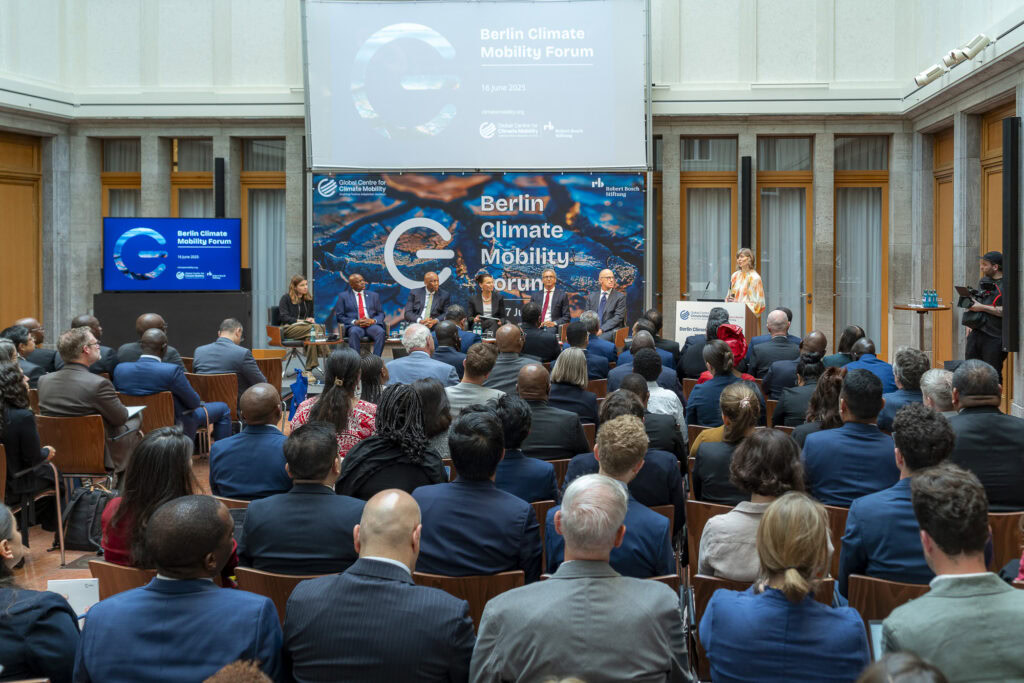
The UN’s Global Centre for Climate Mobility and the Robert Bosch Stiftung convene the 2nd Berlin Climate Mobility Forum in June 2026 to reach agreement on principles for addressing climate mobility.
- The high-level forum brings together 14 heads of state, over 60 ministers and leaders from across the globe, representing some 80 countries to advance global cooperation on climate mobility.
- A central outcome of the Forum will be the endorsement of the “Global Climate Mobility Principles”, a high-level consensus on the need to enable positive adaptation journeys by protecting people’s “right to stay” and relocation with dignity.
- The Forum will also serve to discuss a roadmap for translating these shared objectives into concrete partnerships and action.
Berlin, 04 June 2026 – At a pivotal moment for global climate action, the 2nd Berlin Climate Mobility Forum (BCMF), co-hosted by the Global Centre for Climate Mobility (GCCM) and the Robert Bosch Stiftung, will convene in Berlin on 18–19 June 2026 to adopt the “Global Principles for Addressing Climate Mobility”. It will also set the tone for the design of the Climate Mobility Adaptation Agenda.
The Forum brings together governments, international organizations, financial institutions, civil society, and frontline leaders to usher in a new era of international cooperation on climate mobility. It will also be attended by heads of state and government from climate-vulnerable regions, including the Presidents of the Republic of the Marshall Islands, the Federated States of Micronesia, and the Republic of Palau, as well as the Prime Ministers of Papua New Guinea and Saint Kitts and Nevis.
This year’s convening is a follow-up to the 1st Forum launched last year to bring the urgent shared priorities of the affected countries across the globe into sharp focus. The leaders underscored how rising sea levels, extreme weather, and the loss of livelihoods are already forcing millions of people to reconsider their futures. By 2050, it is estimated that over 200 million people globally may be forced to leave their homes due to climate-related reasons. Yet global responses have been fragmented, and the participants of last year’s Forum resolved to change the status quo — by turning political commitments into coordinated action that supports communities to adapt, remain where possible, and move safely and with dignity when necessary. Since then, the political momentum has grown rapidly with the development of the global principles for addressing climate mobility, which garnered support from champion countries during COP30 in Belém. The launch of the “Global Climate Mobility Principles” at the 2nd Berlin Climate Mobility Forum will mark a first significant milestone of this effort.
“Climate mobility stands among the defining challenges of our era, calling for anticipatory action, collective international solidarity, and solutions firmly rooted in the lived realities of frontline communities” said Prof. Kamal Amakrane, Managing Director of the UN’s Global Centre for Climate Mobility. “The 2026 Berlin Climate Mobility Forum will convene leaders and partners from across regions to forge a shared vision for the way forward and advance meaningful action that enables people to stay in the places they call home, while ensuring that those who must move can do so in safety, dignity, and hope.”
From Principles to Action: Forum to Launch the Foundations for a Positive Adaptation Agenda
In addition to adopting the Principles, the Forum will seek to accelerate implementation efforts through the “Climate Mobility Adaptation Agenda”. The Agenda aims to align stakeholders to advance practical, scalable responses that enable a positive transition for communities facing serious and often irreversible climate hazards.
“At a time when international cooperation is under increasing pressure, it is crucial for Germany and Europe to show leadership in advancing the global response to climate mobility. As an influential donor and valued partner to many, with its key role in multilateral forums and international financial institutions, Germany has a special ability to move this critical topic forward. And this is not just a distant issue; Europe is also increasingly affected,” said Dr. Bernhard Straub, CEO of the Robert Bosch Stiftung. “Robust international cooperation is the only effective way to address the impacts of climate change on all our societies. The Berlin Climate Mobility Forum provides the platform to drive this collective action.”
By advancing shared principles and forging partnerships, the Forum aims to lay the groundwork for a coordinated global response to climate mobility that supports communities to adapt, stay where possible, and move with dignity when necessary.
The following Heads of State and Government will attend the 2nd Berlin Climate Mobility Forum:
· H.E. Azali Assoumani, President of the Union of the Comoros
· H.E. Nasry Asfura, President of the Republic of Honduras
· H.E. Taneti Maamau, President of the Republic of Kiribati
· H.E. Dr. Hilda C. Heine, President of the Republic of the Marshall Islands
· H.E. Wesley Simina, President of the Federated States of Micronesia
· H.E. Dalton Tagelagi, Prime Minister of Niue
· H.E. Surangel S. Whipps Jr., President of the Republic of Palau
· H.E. James Marape, Prime Minister of the Independent State of Papua New Guinea
· H.E. Dr. Terrance Drew, Prime Minister of Saint Kitts and Nevis
· H.E. Reverend Sir Tofinga Vaevalu Falani, Governor-General of Tuvalu
· H.E. Uz Hussain Mohamed Latheef, Vice President, Republic of Maldives
· H.E. Johnny Koanapo, Deputy Prime Minister, Republic of Vanuatu
More about the Berlin Climate Mobility Forum: Berlin Climate Mobility Forum – Global Centre for Climate Mobility | Robert Bosch Stiftung
About the Global Centre for Climate Mobility
The Global Centre for Climate Mobility (GCCM) is the leading UN entity at the intersection of climate action and human mobility, enabling positive adaptation journeys for people and communities on the frontlines of the climate crisis, upholding their adaptive capacities and “right to stay”. Hosted at the United Nations Office for Project Services, the GCCM is supported by champion countries, UN Agencies, the World Bank, regional organizations, philanthropies, civil society, and research institutions. The GCCM advances positive community transitions in climate-vulnerable regions through regional initiatives that support governments and frontline communities to anticipate, plan for, and respond to climate mobility. The GCCM also enables the Rising Nations Initiative (RNI), which supports Small Island Developing States and low-lying coastal States in addressing the existential threats posed by sea-level rise. The GCCM is structured around three core Practices: the Knowledge & Policy Hub, the Solutions Lab, and the Communities Climate Adaptation Facility (C-CAF), through which the Centre delivers modeling & research analysis, informs policy, co-creates locally led solutions, fosters partnerships, localizes climate finance, and builds capacity across the climate mobility ecosystem. It also enables coalitions for action, serving as the secretariat for the Coalition for Addressing Sea-Level Rise and its Existential Threats (C-SET), the Ocean Rise & Coastal Resilience Coalition, and the Climate Mobility Elders Group.
About the Robert Bosch Stiftung
The Robert Bosch Stiftung is active in the areas of health, education, and global issues. Through its funding, the Foundation works for a just and sustainable future. It is non-profit, independent and non-partisan and is rooted in the legacy of Robert Bosch. In his legacy, the entrepreneur and founder formulated the dual mission of securing the company’s future and continuing his social commitment. The Robert Bosch Stiftung GmbH maintains its own facilities, develops innovative projects, and provides support at both the international and local level. The Foundation contributes findings from these projects to the professional world and public debate.
The Foundation holds around 94 percent of the shares in Robert Bosch GmbH and is financed by dividends. The company and the Foundation are independent of each other. Since its establishment in 1964, the Robert Bosch Stiftung has contributed more than 2.7 billion euros to its charitable work.
Media Contacts:
Press Office | SEC Newgate
Josefine Loß
j.loss@secnewgate.de
Global Centre for Climate Mobility
Loretto Azzopardi, Communications Officer
azzopardi@climatemobility.org